

Why Nostr keys and identity are better for privacy
Why key-based identity changes the privacy trade-offs compared with account-based platforms
 Gary Woodfine Apr 6, 2026
Nostr changes the identity model. On most mainstream platforms, your account exists because a company says it exists. You log in with an email, phone number, password, or platform-issued session. That provider stores the account, controls access, and can often force identity checks, suspend the account, or reset credentials.
Nostr does not work like that.
On Nostr, your identity is based on a cryptographic key pair. Your public key identifies you. Your private key proves you are really you by signing events. That shift matters for privacy because it removes a huge amount of centrally stored account data from the normal operating model.
Nostr stands for "Notes and Other Stuff Transmitted by Relays" and uses cryptographic keys plus relays instead of a single platform-owned account system.
Why this can be better for privacy
1. No default requirement for phone-number or government-ID onboarding
Many centralised platforms want an email address, phone number, and sometimes more. Some now push toward age verification or identity checks that create yet another pile of sensitive user data.
Nostr does not require that at the protocol level. You can generate a key pair without asking permission from a company or handing over identity documents.
That is a meaningful privacy win.
2. Your identity is portable
Your Nostr identity is not trapped inside one company database. If one client is bad, hostile, broken, or full of garbage, you can move to another one and keep the same public identity.
That weakens the usual platform lock-in model where privacy and control are both held hostage by the service operator.
3. Fewer centralised honeypots
Centralised user databases are breach magnets. When one company stores account details, behavioural history, private messages, recovery factors, and identification records for millions of users, the blast radius is massive.
Nostr reduces some of that by not depending on one single operator to manage the entire identity layer.
What people get wrong
This is where a lot of Nostr writing turns sloppy.
Nostr is not automatically anonymous.
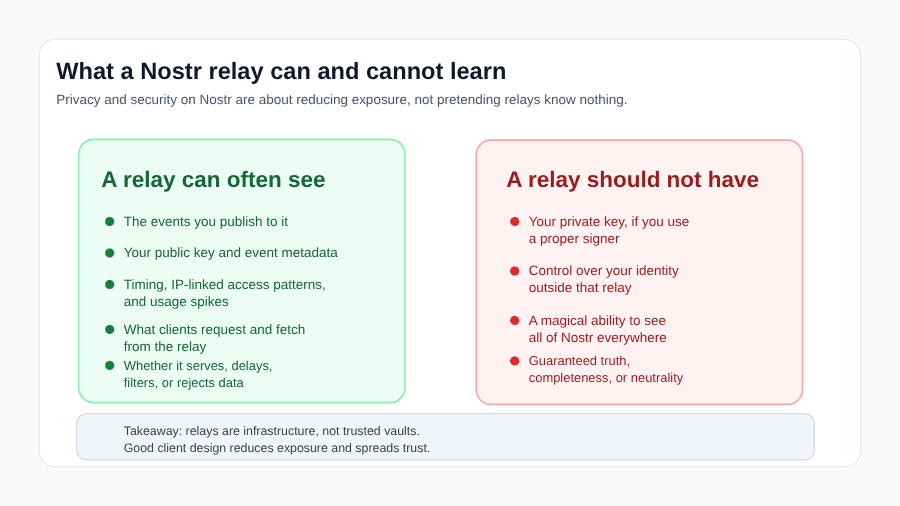
Relays can still see things such as:
- the public events you publish to them
- metadata tied to those events
- timing and activity patterns
- IP-linked access patterns unless additional privacy tools are used
- what a client is requesting or subscribing to
So the honest claim is not "Nostr makes you anonymous". The honest claim is: Nostr can improve privacy by removing some centralised identity dependencies, but your privacy still depends heavily on how you use clients, signers, relays, and network infrastructure.
Why key-based identity is still a big improvement
Fewer account-recovery traps
Traditional platforms rely on account recovery flows that often depend on more centralised identifiers like phone numbers and email. That creates more surveillance surface and more attack surface.
With Nostr, the trade-off is harsher but cleaner: your key is your account.
That means:
- no platform reset button
- no support desk identity appeal flow
- no platform custodian deciding whether you get your account back
This is more self-sovereign, but also less forgiving.
Better separation between identity and application
A Nostr client is not the same thing as your identity. A signer is not the same thing as a relay. A relay is not the same thing as a profile host. That separation gives users more room to choose better privacy tools instead of accepting one vendor-controlled stack.
Why age verification and government-ID models are bad privacy defaults
If a service demands government-issued ID, it creates obvious problems:
- more sensitive personal data collected than is needed
- higher breach impact when that data leaks
- easier profiling, tracking, and correlation
- more opportunities for exclusion, abuse, or mission creep
That criticism is not unique to Nostr, but Nostr makes a useful contrast because the protocol itself does not require that kind of identity collection.
The responsibility shift
Nostr gives users more control, but that comes with more responsibility.
If you want the privacy upside, you still need to do the basics well:
- protect your private key
- use a signer instead of pasting raw keys into sites
- choose relays carefully
- separate identities when needed
- understand that public posts are still public
In other words, Nostr can remove some platform-level privacy problems, but it does not remove operational-security mistakes.
Conclusion
Nostr is better for privacy in one very important sense: it replaces centrally managed account identity with user-controlled cryptographic identity. That lowers dependence on phone-number onboarding, platform recovery systems, and giant centralised identity databases.
But the smart version of the claim is narrower than the hype. Nostr is not private by magic, and it is not anonymous by default. It is simply a better foundation for privacy if the surrounding tools and habits are not stupid.
References

Author
Gary Woodfine
Managing Director
independent software developer, vendor, architect, consultant, blogger, Bitcoin & Nostr Enthusiast. I've provided software development expertise and helped augment software development skills and teams for a number of startups, product companies, corporate IT shops, and consulting firms.