


How to Choose Nostr Relays
A practical guide to picking better relays for privacy, reliability, and reach
 Gary Woodfine Apr 11, 2026
One of the fastest ways to make your Nostr experience worse is to treat relay choice like it does not matter.
It matters a lot.
The relays you publish to and read from affect:
- whether your posts are seen
- whether replies and mentions show up consistently
- how much spam you deal with
- how much metadata you leak to operators
- how reliable your daily use feels
Be deliberate in your choice of relays, Do not just dump in random URLs and hope for the best.
Start with what a relay actually is
A relay is a server that accepts, stores, and forwards Nostr events.
If you want the full primer first, read What is a Nostr Relay?.
This article is about selection, not theory.
What makes a good Nostr relay?
There is no perfect relay, but there are some practical things worth looking for.
1. Reliability
A relay that is frequently offline or unstable is a bad default.
If your client constantly waits on dead or unreliable relays, your Nostr experience gets slower and less predictable.
Look for relays that:
- stay online consistently
- respond quickly enough for normal use
- are not obviously abandoned
2. Sensible moderation or anti-spam posture
Nostr is open protocol, but that does not mean every relay is of a high quality.
Some relays are effectively junk feeders. They may be full of spam, garbage indexing, or low-effort relay listings that make client User Experience (UX) worse.
A good relay does not need to be authoritarian, but it should not be useless either.
3. Clear capabilities
Some relays expose metadata through NIP-11, the Relay Information Document. That can tell clients and users things like:
- the relay name and description
- supported NIPs
- software and version
- operator contact details
{
  "name": <string identifying relay>,
  "description": <string with detailed information>,
  "banner": <a link to an image (e.g. in .jpg, or .png format)>,
  "icon": <a link to an icon (e.g. in .jpg, or .png format>,
  "pubkey": <administrative contact pubkey>,
  "self": <relay's own pubkey>,
  "contact": <administrative alternate contact>,
  "supported_nips": <a list of NIP numbers supported by the relay>,
  "software": <string identifying relay software URL>,
  "version": <string version identifier>,
  "terms_of_service": <a link to a text file describing the relay's term of service>
}
That is useful because it gives you at least some information about what the relay claims to support.
It is especially useful when you care about features like:
- search support
- relay-specific limits
- auth requirements
- software maturity
4. Relevant feature support
Not every relay supports the same optional features.
For example, NIP-50 defines a search capability using a search filter field. If a client wants to support search-driven workflows, it helps to know which relays advertise support for it.
That does not mean every relay must support every NIP. It means you should avoid assuming they all do.
5. Reasonable fit for your use case
A relay that works well for public social posting may not be the one you want for everything else.
Your ideal relay mix depends on what you would like achieve or what your typical activities comprise.
For example:
- public posting
- profile discovery
- mentions and replies
- long-term availability
- search-heavy use
- lower-noise reading experience
Do not rely on a single relay
This is the biggest practical mistake beginners make.
Using one relay means:
- one outage hurts you more
- one operator sees everything you do on that relay
- one policy change can wreck your experience
- one spam-heavy relay can dominate your view of the network
Using multiple relays gives you:
- better redundancy
- better reach
- better resilience
- less dependence on one operator
NIP-65 even recommends keeping relay lists relatively small and intentional, rather than huge and chaotic. That is a useful instinct. Small and good usually beats large and messy.
Read relays and write relays should be intentional
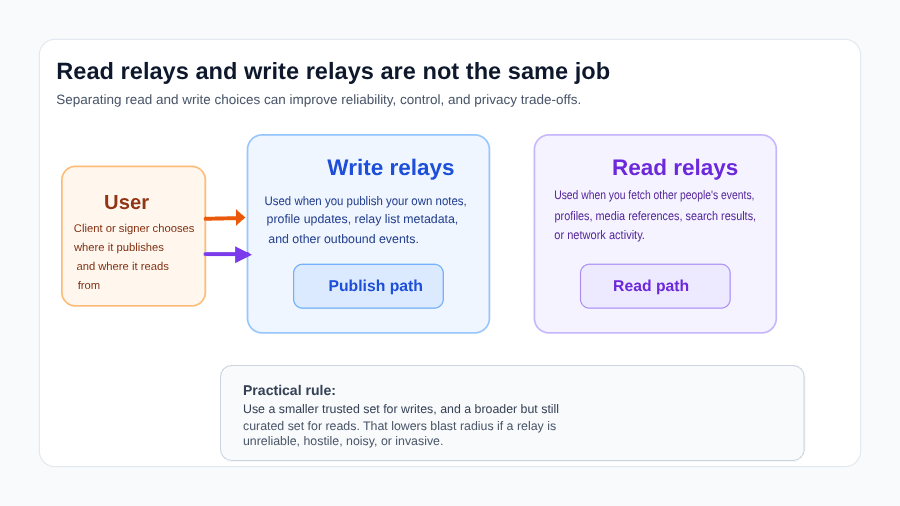
NIP-65 defines kind 10002 relay list metadata, where a user can advertise relays with optional read or write markers.
That matters because the relay you publish to and the relay you read from do not always need to be identical.
A useful mental model is:
- write relays should be dependable enough for publishing your own events
- read relays should be good at helping you retrieve the content that matters to you
A client should not blindly treat every discovered relay as equally good for both jobs.
Privacy questions to ask before adding a relay
Nostr is more decentralised than a typical social platform, but relays still see things.
A relay operator may be able to observe:
- your IP address
- when you connect
- what you publish to that relay
- what queries you make
- what accounts or event patterns you appear interested in
So before adding a relay, ask:
- do I trust this operator enough for this use?
- do I need this relay, or am I just adding noise?
- am I spreading activity too thinly across random infrastructure?
- am I confusing decentralisation with privacy guarantees?
That last one matters. Public events are still public. Relay diversity helps, but it does not turn public social activity into private activity.
Security questions to ask before adding a relay
The relay does not hold your private key if you are using a proper signer like Diogel, which is good.
But security is broader than just key theft.
A low-quality relay can still harm your experience on nostr by:
- serving incomplete or poor-quality data
- dropping your publishes
- creating noise and confusion
- degrading search and discovery
- adding operational friction to your client setup
So a practical security mindset includes relay quality, not just key handling.
If you need the key-management side first, read:
A practical relay selection checklist
When evaluating a relay, common questions to ask:
- Is it reachable and stable?
- Does it look abandoned or actively operated?
- Does it expose useful NIP-11 metadata?
- Does it support features I actually care about?
- Is it obviously spam-heavy or junky?
- Is it a sensible choice for read, write, or both?
- Is it improving my setup, or just increasing noise?
That last question is underrated.
Many relay lists get worse because they become a pile of random URLs collected without discipline and forethought.
Avoid these common mistakes
Adding every relay you can find
More is not automatically better.
A huge low-quality relay list can create:
- more dead connections
- more duplicates
- more junk
- slower UX
- harder troubleshooting
Treating relay metadata as perfect truth
NIP-11 and relay list metadata are useful, but they are still inputs, not guarantees.
Clients should use them intelligently, not blindly.
Assuming decentralization means no trust decisions
Decentralization changes where trust decisions happen. It does not eliminate them.
You still have to decide:
- what infrastructure to use
- which operators to trust enough
- how much redundancy you want
- how much visibility you are willing to give a relay
Why good relay management matters in Diogel
One reason relay management matters in products like Diogel is that bad defaults create bad habits.
If a relay browser or relay picker shows users:
- dead relays
- spammy relays
- random junk
- no quality cues
then the feature becomes technically functional but practically poor.
Good relay management should help users make better decisions with less friction.
Conclusion
Choosing Nostr relays is not about finding one magical server. It is about building a small, deliberate set of relays that improves:
- reach
- reliability
- discoverability
- privacy posture
- overall usability
The best relay setup is usually not the biggest one. It is the one that is intentional, understandable, and good enough for the way you actually use Nostr.
References
Best Nostr Browser Extensions (2026): Complete Comparison
Compare the best Nostr browser extensions of 2026. We review Diogel, Alby, Nos2x, and Nsec.app to help you choose the right NIP-07 signer for secure key management.
Getting Started with Nostr: Complete Diogel Setup Guide (2026)
Learn how to set up Diogel Nostr signer in 5 minutes. Complete walkthrough for Chrome and Firefox with screenshots. Secure key management made simple for Nostr beginners.